Overview
Mindmaps are a type of diagram used to visually organise information in a hierarchial manner. They’re fundamentally a subtype of {spider map, concept map, conceptual diagram}.
These sorts of diagrams are often used for brainstorming/creativity and for notetaking.
As someone who does a lot of worldbuilding and a lot of studying, I’m motivated to learn more about the effective use of these diagrams for both of those purposes (brainstorming and notetaking).
GRINDE
Some YouTube personality (Justin Sung) who may or may not be a reputable source for learning-related methodologies came up with a model called GRINDE
The fundamental purpose of this model is to transform raw input (things you see/hear/experience) into knowledge. The process of transforming data in this manner is called “encoding.”
The steps are as follows:
Grouping
Confer: chunking, scaffolding, mental models, taxonomy(?)
Grouping is simply putting related ideas together. Whatever criteria we utilise for grouping things can be somewhat arbitrary, and varies from person to person.
For example, sorting a collection of pens might be done by type {fountain, ballpoint, dip}, or colour, or the type of ink that’s inside them.
Additionally, information as it’s taught/presented to you might already be pre-sorted into groups.
What’s most important about the grouping step is to figure out what’s the most memorable or easily understood to you.
Benefits
The two benefits of grouping are:
- Promotes deeper understanding of material or concepts
- Enhances your ability to recall or remember information
Relational (Relating)
Relating is taking your groups and the items within those groups and mapping out the relations between them.
Sung says that he observes three stages that emerge when people are learning to relate things:
- Too few relationships
- Too many relationships
- A well organised amount of relationships (a golden mean)
The fact that it’s easy to get carried away trying to come up with relationships between items is something to be mindful of.
Just like how grouping can be done with arbitrary criteria, there are loads of different relationships that can be used for relating things, i.e:
- Influences
- Cause and effect
- Chronological relationships
- Any combination and more
When relating things to one another it’s important to be mindful which relationships are significant enough to note, or else your notes are going to end up flooded with arrows.
Just like grouping, relating your information should be done in the manner that’s best for you. Your personal notes are there to help you understand and recall information; if you’re just trying to make them look pretty for clout, maybe you should reevaluate why you’re taking notes in the first place.
Interconnection
The interconnection step is basically making sure that the there’s an easily understood big picture that unites your groups and their children.
In a mindmap that’s poorly interconnected, you may see well-established groups with lots of children and established relationships, but the children of said groups end up being somewhat isolated/silo’d from the rest of the map basically forming islands deeply compartmentalised pockets.
The formation of islands or poorly connected notes is said to be the result of tunnelvision or failing to consider how what you’re learning at the moment is connected/related to the big picture.
Looking at the examples that Sung shows as being poorly interconnected vs well interconnected seems to indicate that the poorly interconnected ones are more arboreal whereas the better ones are rhizomatic.
In a more arboreal model, the branches/stems at the end of each path grow more and more distant from the other nodes, but in a rhizomatic model the nodes seem to be more logically connected. (See example of nodes connected rhizomatically below)
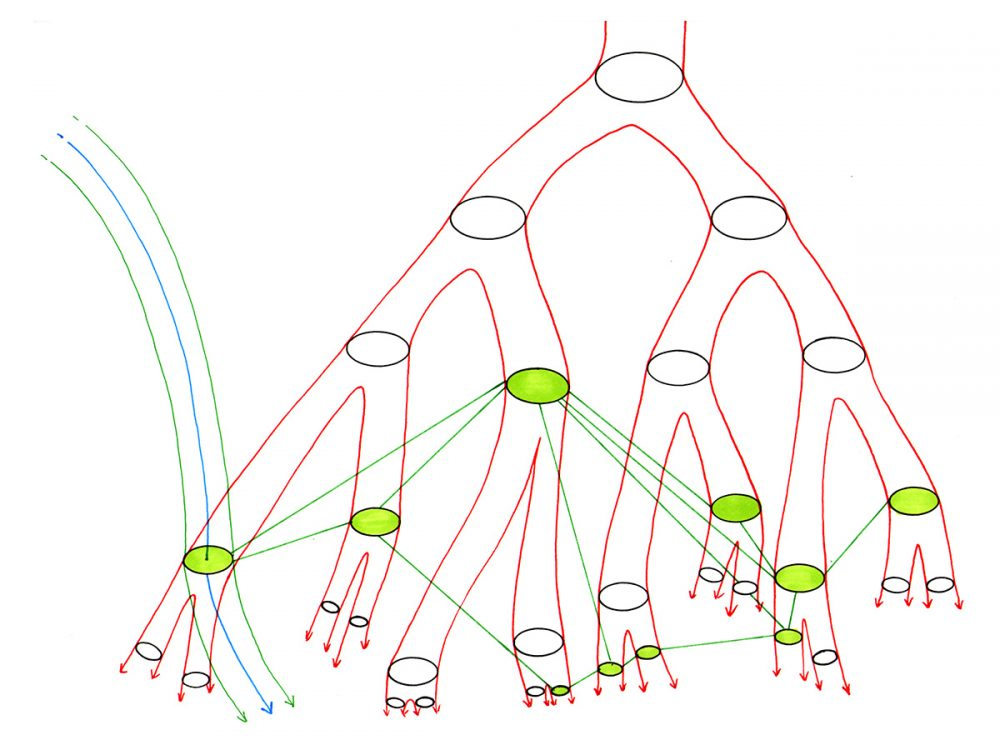
By going through the process and making sure that notes are well grouped, related, and interconnected we’re effectively creating a knowledge schema, which is a system or language that our brain uses to organise knowledge.
Non-verbose
(Sung calls this non-verbal in his lecture, but he’s really talking about not being overly wordy)
According to the literature on the subject, taking overly verbose notes actually has a deleterious effect on your comprehension and retention of material.
Consequently when taking notes it’s important to focus on what’s actually important and maintain a good signal:noise. Being less verbose also allows one the opportunity to take advantage of something called the generation effect which is basically the beneficial effect gained from explaining something in your own words or producing known synonyms for a concept (producing relationships between existing knowlege?). I imagine that when you’re just writing down someone else’s explanation verbatum, it’s in one ear and out the other, but if you reduce down to its simplest parts and then later expand on it yourself, you’re actually processing the information instead of just copying it blindly. (active learning vs passive instruction)
One way to be less verbose specifically while mind mapping, is to take advantage of the visual aspect of the medium and use arrows, lines, and spatial arrangement to your advantage. By letting the visual aspect of the thing speak for itself you’re also availing yourself to question the grouping, relationships, and interconnected of the things at the same time.
Another of Sung’s suggestions under the category of non-verbosity is to add landmarks to your maps to remind of you of the highlights. This kinda reminds me of “cues” in Cornell notes.
Directionality (Flow)
Directionality is basically making sure that the ideas expressed are interacting with each other in a meaningful way.
The use of arrows and the way you model your relationships can completely change the appearance and the usefulness of your map. That is to say, you can have good grouping, relationships, and interconnectivity, but poor directionality.
The point of having good directionality or flow is to ensure:
- The nature and connection of relationships is well-understood
- You can actually read your bloody map
Another way to think of directionality is something that provides meaning and context to your map.
Emphasised
A “perfect” mind map is one that’s properly emphasised. That is to say that when you’re taking notes, you’re making a conscious decision about what to include/exclude, and what relationships to specifically highlight. This is analogous to “evaluating” in Bloom’s Taxonomy of Learning.
Proper emphasis creates something of a “backbone” that’s visible in a map, whether through bolding or any other kind of visual emphasis. Making a deliberate choice about what to emphasise and what not to is another thing that encourages one to actively engage with the material in a way that they wouldn’t if they were just copying it down blindly
Further, this sort of thinking (important vs unimportant, emphasised vs unemphasised) about presented material also encourages recursive thinking vs excursive thinking, which helps to overcome “getting stuck” on a concept. Being able to explain what is or isn’t noteworthy and why is a hallmark of comprehension/expertise.
My thoughts on the subject
I don’t think much of Sung’s lecture or methodology is necessarily useful for creative purposes, but for learning purposes I think a lot of what he prescribed is useful far beyond the context of mindmaps. The GRINDE model is basically an algorithm that takes raw input (experiences, lectures, books, etc.) and encoding them into comprehensible and memorable (easily recalled) knowledge.
Learning seems to be a series of processes:
- Being exposed to and capturing raw information
- Thinking about how to sort that information (under what groups, what taxonomy)
- Establishing relationships between that information
- Ensuring the relationships make sense or are significant
- Understanding why some things are more or less significant than others in your comprehension of a thing
Generally speaking, my favourite type of notetaking is outlining and that’s what I’ve used for most of my life. I like outlines because they’re already hierarchial and have clearly visible groups, and if you need to you can draw arrows in the margins to show relationships. It’s also just the quickest way for me to jot down what seems important to me during lectures.
Using tools like Logseq or Obsidian, it’s also possible for each item or node in an outline to be its own page, and to model relationships and interconnectivity between them. Also to add things like tags and metadata in order to further demonstrate those things.
That being said, I’m probably going to stick to outlines as my preferred method of detailed notetaking, but I’m going to try and use mindmaps for big picture overviews of complex topics. Width rather than depth, I suppose.
I guess I also want to try using maps to summarise existing notes, and still to try and model complex worldbuilding and setting related stuff for creative purposes.